
Bonding Agent vs Cement Slurry: Which Gives Better Adhesion?
Good construction is not only about strong materials. It is also about how well those materials bond with each other.
Whether you are plastering a wall, repairing concrete, applying a waterproof coating, or doing patch work, adhesion plays a major role. If the new layer does not stick properly to the old surface, the work may fail early.
This is why bonding becomes important.
Traditionally, many workers use cement slurry before plastering or repair work. It is a simple mixture of cement and water. But in modern construction, bonding agents are becoming more preferred because they are specially made to improve adhesion between surfaces.
So, which one gives better adhesion: bonding agent or cement slurry?
Let’s understand this in simple language.
No h3 tags found inside Content.
What Is Cement Slurry?
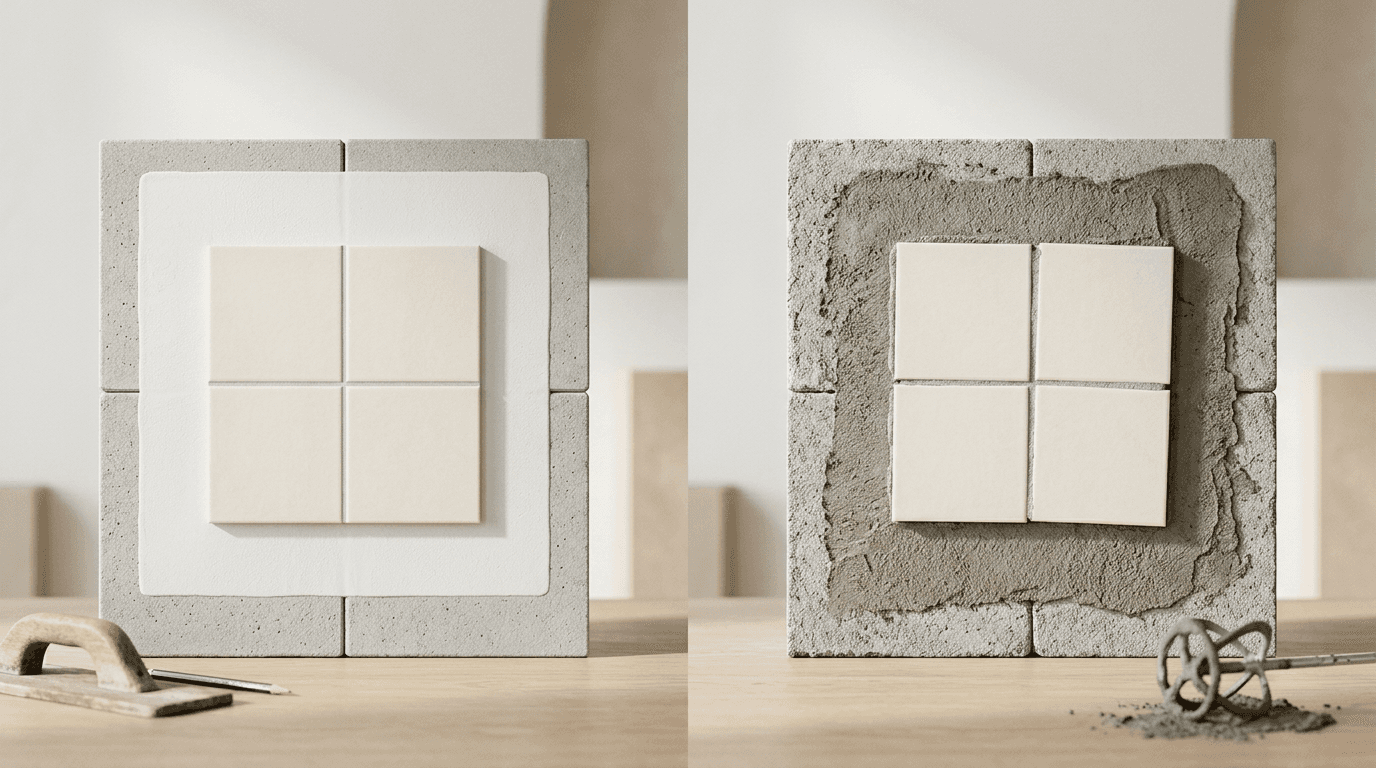
Cement slurry is a basic mixture of cement and water. It is usually applied on a surface before plastering, tile fixing, or repair work to create a bonding layer.
It is commonly used because it is easy to make at site and feels economical.
In many construction sites, cement slurry is used before applying fresh mortar on old concrete or masonry surfaces.
What Is a Bonding Agent?
A bonding agent is a specially formulated construction chemical used to improve the bond between old and new surfaces.
It can be used between:
Old concrete and new concrete
Old plaster and new plaster
Concrete and repair mortar
Cement surface and waterproof coating
Masonry surface and plaster
Smooth concrete and cement-based material
Bonding agents are usually made using polymer, acrylic, SBR, epoxy, or other modified chemical systems depending on the application requirement.
Their main job is simple: help one layer stick better to another layer.
Why Adhesion Matters in Construction
When a new layer is applied on an existing surface, it must hold strongly. If the bond is weak, the layer may separate over time.
Poor adhesion can lead to:
Hollow plaster
Cracks
Surface peeling
Repair failure
Tile debonding
Waterproofing failure
Patch separation
Flaking
Water entry through gaps
A strong bond helps the surface perform better and last longer.
Cement Slurry: Advantages
Cement slurry has been used for many years and still has some practical advantages.
1. Easy to Prepare
Cement slurry is very simple to make. Workers only need cement and water. This makes it convenient on construction sites.
2. Low Initial Cost
Since cement is already available at most sites, cement slurry feels like a low-cost solution. This is one reason why it is still commonly used.
3. Familiar to Workers
Most masons and contractors are already familiar with cement slurry. They know how to mix and apply it in basic construction work.
4. Useful for Basic Applications
For simple, low-risk applications on rough and absorbent surfaces, cement slurry may provide some level of bonding support.
However, the performance depends heavily on surface condition, timing, water ratio, and workmanship.
Cement Slurry: Limitations
Although cement slurry is common, it has several limitations.
1. Weak Bonding on Smooth Surfaces
Cement slurry does not bond well with smooth, dense, or low-porosity surfaces. For example, old concrete, dense plaster, or RCC surfaces may not hold slurry strongly.
If the surface is too smooth, slurry may dry on top instead of bonding properly.
2. Can Dry Too Quickly
Cement slurry can dry quickly, especially in hot weather. If fresh mortar is not applied at the right time, the slurry layer may become weak and dusty.
Once it dries completely, it may not act as a good bonding bridge.
3. No Flexibility
Cement slurry is rigid. It does not handle movement, shrinkage, or thermal changes well.
This can lead to cracks or separation in repair areas where slight movement may happen.
4. Inconsistent Site Mixing
The quality of cement slurry depends on how it is mixed at site. If workers add too much water, the slurry becomes weak. If the mix is too thick, it may not spread properly.
There is no strong quality control unless the process is carefully monitored.
5. Poor Performance in Repair Work
Repair work needs strong bonding because the new material must hold properly onto an old surface. Cement slurry often does not provide enough adhesion for durable repair, especially in critical areas.
Bonding Agent: Advantages
Bonding agents are designed to solve many of the limitations of cement slurry.
1. Better Adhesion
The main benefit of a bonding agent is improved adhesion. It helps the new layer bond strongly with the existing surface.
This makes it useful for plastering, repair mortar, waterproof coatings, and concrete bonding applications.
2. Works Better on Old Surfaces
Old surfaces are often dusty, smooth, weak, or less absorbent. A bonding agent improves the connection between the old surface and the new material.
This is especially helpful during renovation and repair work.
3. Reduces Chances of Debonding
Debonding happens when the applied layer separates from the surface. It can happen in plaster, repair patches, waterproofing layers, or coatings.
Bonding agents help reduce this risk by creating a stronger bonding bridge.
4. Improves Durability of Repairs
Repair work fails quickly when the repair mortar does not stick well. A bonding agent helps the repair material hold better and last longer.
It is useful for:
Concrete patch repair
Plaster repair
Crack repair
Column and beam repair
Wall surface repair
Waterproofing repair
5. Better Performance in Waterproofing Work
Waterproof coatings need strong bonding with the base surface. If the coating does not stick properly, water can enter and damage the system.
Bonding agents help improve the adhesion of cementitious waterproof coatings and reduce the chances of coating failure.
6. More Controlled Performance
Unlike cement slurry, bonding agents are manufactured with specific formulations. This gives more predictable performance when the product is used as per instructions.
Correct mixing ratio and application method are still important, but the product itself is designed for better bonding.
7. Can Improve Strength and Flexibility
Some bonding agents also improve the strength, flexibility, and water resistance of cement-based mixes. This depends on the type of bonding agent used.
For example, polymer-based bonding agents can improve the performance of repair mortar, plaster, and waterproof coatings.
Bonding Agent: Limitations
Bonding agents offer better performance, but they must be used correctly.
1. Higher Initial Cost
A bonding agent usually costs more than cement slurry. But the extra cost can be justified if it prevents repair failure, debonding, or repeated maintenance.
2. Requires Correct Product Selection
Not every bonding agent is suitable for every job. Some are meant for plaster bonding, some for concrete repair, some for waterproofing, and some for structural bonding.
Using the wrong product can reduce performance.
3. Needs Proper Surface Preparation
A bonding agent cannot perform well on a dirty, oily, weak, or loose surface. The surface must be cleaned and prepared properly before application.
4. Must Be Applied as Per Instructions
Mixing ratio, drying time, open time, and application thickness matter. If the product is over-diluted or applied incorrectly, adhesion can be affected.
Bonding Agent vs Cement Slurry: Quick Comparison
Factor | Cement Slurry | Bonding Agent |
Composition | Cement and water | Special polymer, acrylic, SBR, epoxy, or modified system |
Adhesion strength | Basic | Better and more reliable |
Performance on old surfaces | Limited | Better |
Performance on smooth concrete | Weak to moderate | Better, depending on product type |
Flexibility | Very low | Better in polymer-based systems |
Water resistance | Limited | Better in suitable formulations |
Site quality control | Inconsistent | More controlled |
Cost | Lower initial cost | Higher initial cost |
Durability in repair work | Limited | Better |
Risk of debonding | Higher | Lower when applied correctly |
Best use | Basic non-critical work | Repair, plaster bonding, waterproofing, concrete bonding, renovation |
Which Gives Better Adhesion?
In most cases, a bonding agent gives better adhesion than cement slurry.
Cement slurry can work in basic applications, especially where the surface is rough, clean, and absorbent. But it is not the best choice for modern repair work, waterproofing, smooth concrete surfaces, or areas where long-term durability is important.
Bonding agents are specially designed to improve adhesion. They create a stronger connection between the old surface and the new material.
So, if the goal is better bonding, stronger repair, and longer-lasting performance, a bonding agent is usually the better choice.
When Can Cement Slurry Be Used?
Cement slurry may be used for basic work where performance demand is low. For example, it may be used on rough masonry or fresh cement-based surfaces where the bonding requirement is not very critical.
But even in such cases, application timing is important. The fresh mortar should be applied while the slurry is still wet and active. If the slurry dries before application, bonding can become weak.
When Should You Use a Bonding Agent?
A bonding agent is a better choice when you need stronger and more reliable adhesion.
Use a bonding agent for:
Old concrete to new concrete bonding
Plaster repair
Concrete repair
Smooth RCC surfaces
Waterproof coating application
Patch repair
Renovation work
Areas exposed to moisture
External wall repair
Surfaces where cement slurry may not bond properly
In short, bonding agents are more suitable where failure can lead to cracks, peeling, leakage, or repeated repair.
Common Mistakes to Avoid
Even a good bonding agent can fail if the application is wrong. Avoid these common mistakes:
1. Applying on Dusty Surface
Dust creates a weak layer between the surface and the bonding material. Always clean the surface properly before application.
2. Ignoring Loose Material
Loose plaster, weak concrete, and flaking paint should be removed first. Bonding agent should be applied only on a sound surface.
3. Using Too Much Water
Over-diluting the bonding agent or cement slurry reduces performance. Always follow the recommended mixing ratio.
4. Waiting Too Long Before Applying the Next Layer
Some bonding systems require the next layer to be applied while the bonding coat is tacky or wet. If you wait too long, bonding may be affected.
5. Using the Wrong Product
A plaster bonding agent may not be suitable for structural concrete bonding. A waterproofing additive may not replace a proper bonding agent. Choose the right product for the application.
6. Skipping Surface Roughening
Very smooth concrete surfaces may need mechanical roughening before applying any bonding material. This improves mechanical grip.
7. Applying on Damp or Contaminated Surfaces Without Checking
Some bonding agents work on slightly damp surfaces, while others need dry surfaces. Oil, grease, curing compounds, and chemical contamination must be removed before application.
Best Practices for Better Adhesion
To get strong bonding, follow these basic steps:
Clean the surface properly
Remove loose material
Repair cracks or damaged areas
Roughen smooth surfaces if required
Use the right bonding agent for the job
Mix the product as recommended
Apply evenly on the surface
Apply the next layer within the recommended time
Allow proper curing or drying
Avoid shortcuts in surface preparation
Adhesion depends on both product quality and application quality.
Final Thoughts
Cement slurry is simple, familiar, and low-cost, but it has limitations. It may not provide strong and reliable adhesion in many modern construction and repair applications.
A bonding agent is designed specifically to improve adhesion. It performs better on old surfaces, repair areas, smooth concrete, waterproofing systems, and renovation work.
So, when comparing bonding agent vs cement slurry, the better choice for adhesion is usually clear.
For basic work, cement slurry may be acceptable. But for stronger bonding, better durability, and reduced chances of failure, a quality bonding agent is the smarter option.
A strong construction layer does not just need good material. It needs good bonding.



Products
Gypsum & Plasters
Wall Putty
Primers
Emulsion & Additives
Construction Chemicals
Tile Adhesive
Repair & Bond
Panels & Accessories
Resources
Blogs
Careers
Privacy Policy
Terms & Conditions
Sitemap
Contact
A: Sakarni Plaster (India) Pvt. Ltd,
Plot No. 29, NWA Road
Punjabi Bagh West
New Delhi – 110026
P: +91 9810177365
E: info@sakarni.com
Get a Quote
Become Dealer
Google Map
